XILINX 17128C Prom Ic 9446 DIP8 128KB
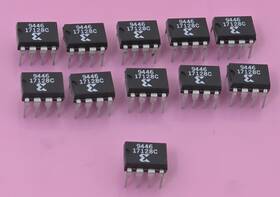
( Brand: Xilinx ), ( Manufacturer Part Number: 17128C )
Review XILINX Lot Of 128kb Prom Ic
The **Xilinx XC17128C-9446 (DIP8, 128KB PROM IC)** is a high-performance, erasable programmable read-only memory (EPROM) device designed for applications requiring reliable, non-volatile storage with fast access times and robust reprogrammability. Part of Xilinx s legacy programmable logic family, this chip combines the reliability of UV-erasable memory with the flexibility of field-programmable logic, making it ideal for embedded systems, firmware storage, boot code, lookup tables, and custom logic implementations where traditional ROM or flash memory may fall short. Encased in an industry-standard **8-pin DIP (Dual Inline Package)** format, the XC17128C-9446 offers a compact yet versatile solution for designers working with older or legacy systems that require direct compatibility with discrete memory components. With a **128KB (16KB x 8-bit) addressable memory space**, it provides ample storage for firmware, configuration data, or small-scale logic functions, all while maintaining the ability to be reprogrammed via ultraviolet (UV) light after erasure a feature that distinguishes it from one-time programmable (OTP) or masked ROM alternatives.
Under the hood, the XC17128C-9446 operates at a **4MHz maximum clock speed**, ensuring efficient data retrieval with minimal latency, which is critical for applications like microcontroller bootloaders, peripheral interfaces, or real-time control systems. Its **9446 designation** indicates a specific variant within the Xilinx family, likely optimized for compatibility with older microprocessors or development boards that rely on discrete PROMs for firmware storage. The chip s **8-bit data width** allows for straightforward interfacing with 8-bit microcontrollers or processors, simplifying address and data bus connections while maintaining flexibility for expansion or parallel processing tasks. Unlike modern flash memory, which may require complex drivers or wear-leveling algorithms, the XC17128C-9446 offers a straightforward, plug-and-play solution with minimal overhead, making it a preferred choice for prototyping, educational projects, or legacy system upgrades where simplicity and reliability are paramount.
One of the standout features of this PROM is its **UV-erasable nature**, which enables multiple reprogramming cycles without the risk of data corruption associated with electrical wear in flash-based alternatives. This makes it particularly useful in applications where firmware updates are infrequent but necessary, such as in industrial control systems, medical devices, or automotive diagnostics where long-term reliability and ease of field modifications are essential. The chip s **non-volatile storage** ensures that data persists even during power cycles, eliminating the need for backup mechanisms or redundant storage solutions. Additionally, the XC17128C-9446 s compatibility with **Xilinx s programmable logic architecture** allows it to function not just as passive memory but also as a configurable logic element in certain designs, enabling designers to integrate storage and logic functions into a single, space-efficient package a feature that was revolutionary in its time and still valuable in niche applications today.
For engineers and hobbyists working with **8-bit microcontrollers** like the Intel 8051, Motorola 6800, or Zilog Z80, the XC17128C-9446 serves as an excellent drop-in replacement for traditional PROMs, offering the same pinout and functionality while adding the flexibility of reprogrammability. Its **DIP8 package** ensures easy breadboarding, prototyping, and integration into through-hole soldering applications, making it a favorite among retrocomputing enthusiasts, vintage hardware restorers, and developers working on minimalist embedded systems. While modern alternatives like SPI flash or NOR memory offer higher densities and faster write speeds, the XC17128C-9446 remains a compelling choice for applications prioritizing simplicity, compatibility, and the tactile reliability of discrete components. Whether used in a classic arcade game, a retro gaming console, or a custom embedded controller, this PROM delivers a blend of performance, durability, and ease of use that continues to make it a valuable component in both educational and professional settings.
### **Xilinx 17128C (9446 DIP8, 128KB PROM IC) Pros and Cons**
#### **Pros:**1. **High Capacity for Its Era** The 128KB (16K x 8-bit) capacity was substantial for early microcontroller and embedded systems, allowing storage of firmware, lookup tables, or small programs without external memory.
2. **DIP Package Compatibility** The DIP-8 package makes it easy to prototype and integrate into breadboards or older circuit boards without requiring specialized sockets.
3. **Non-Volatile Storage** Unlike RAM, PROM retains data even when power is removed, making it ideal for bootloaders, firmware storage, or configuration data.
4. **Simple Interface** Address and data lines are straightforward, requiring minimal control logic for read operations.
5. **Legacy System Support** Useful in retro computing, hobbyist projects, or restoring older systems where modern flash memory isn t available or practical.
6. **No Write Protection Issues** Unlike EPROM (which requires UV erasure), PROM is one-time programmable (OTP), eliminating the need for erasure cycles.
7. **Low Power Consumption** Suitable for battery-powered or low-power applications where minimal current draw is critical.
#### **Cons:**1. **One-Time Programmability** Once programmed, the chip cannot be modified or erased without replacement, making it impractical for iterative development.
2. **Limited Availability** Modern electronics have largely shifted to flash memory (EEPROM, SPI flash), making this chip difficult to source, especially in bulk.
3. **Slower Access Times** Compared to modern memory, the 17128C has relatively slow read speeds, which may be a bottleneck in high-performance applications.
4. **No In-System Programming (ISP)** Unlike modern flash chips, it cannot be programmed without a dedicated PROM programmer, adding complexity to integration.
5. **No Write/Erase Capability** Unlike EEPROM or flash, it lacks the ability to update data after initial programming, limiting flexibility.
6. **High Pin Count for Small Size** While DIP-8 is manageable, the chip s functionality is somewhat limited by its physical form factor compared to modern surface-mount alternatives.
7. **No Built-in Protection Mechanisms** Unlike modern memory, it lacks features like write protection pins or error correction, increasing risk in critical applications.
---
### **Conclusion**
The **Xilinx 17128C (9446 DIP8, 128KB PROM)** is a niche component best suited for **legacy systems, retro computing, or projects where non-volatile, one-time programmable storage is required**. Its strengths lie in its simplicity, non-volatility, and compatibility with older hardware, but its limitations such as lack of reprogrammability, slow speeds, and limited availability make it impractical for modern development. If you need **reusable, high-speed, or easily updatable memory**, modern alternatives like **EEPROM, SPI flash, or microcontrollers with onboard memory** are far superior.
---
### **Recommendation**
- **Buy if:**- You are working on a **retro computing project** (e.g., restoring an old microcomputer).
- You need **non-volatile, one-time storage** in a system where reprogramming isn t required.
- You are using it in a **low-power, legacy application** where modern memory isn t compatible.
- You have a **specific use case** (e.g., storing a fixed firmware image) and can accept the limitations.
- **Avoid if:**- You need **reprogrammable or updatable memory** (use EEPROM or flash instead).
- You are developing **modern embedded systems** (modern memory is faster, cheaper, and more flexible).
- You require **high-speed access** or **large-scale storage** (modern alternatives are far superior).
- You cannot source the chip easily (availability is a major concern).
For most new projects, **modern memory solutions (e.g., 24LC series EEPROM, Winbond flash, or microcontroller-internal memory) are strongly recommended** due to their flexibility, speed, and widespread availability. The 17128C is primarily of historical or niche interest.
Details:
Lot of 11 Xilinx 17128C 9446 DIP8 128Kb PROM IC, New, old stock, Lot IC. For more details, please refer the photos included with listing.
part #: 17128c prices
- $69.98-$199.98
specifications electricalmiscoz:
- brand: Xilinx
- mpn: 17128c
returns electricalmiscoz:
- policy: Returns Accepted
- paid by: Seller
- method: Money back
- time: 30 Days
shipping electricalmiscoz:
- cost: $0.00
- service: USPS Ground Advantage
- transit: 4-10 Days
- type: Calculated
- carrier: USPS
- class: Standard
payments electricalmiscoz:
- credit card: Diners-club
- other
- wallet: Apple-pay
offer electricalmiscoz:
- availability: In Stock
- quantity: 1
- sold: 0
- started: February 21, 2026
- options: Ship-to-home
general electricalmiscoz:
- Electrical Supplies > Electrical Wire Cable Accessories > Electrical Wire Cable Connectors
- condition: Open box
seller electricalmiscoz:
- rating: 100.0%
- city: Glendale, Arizona
- # reviews: 1704
Xilinx 17128C Is Similar To:
- Xilinx 1736dpc Lot Of 7 325233 Dip8 36kb Prom Ic (73.7% similar) For more details, please refer the photos included with listing. Lot of 7 Xilinx 1736DPC 325233 DIP8 36KB prom ic, new, old stock, lot ic...(February 21st, 2026)