COMMON SENSE MARINE MW16-WH-100 Gauge Boat Cable Wire Tinned Copper Oxygen 100-FT Awg
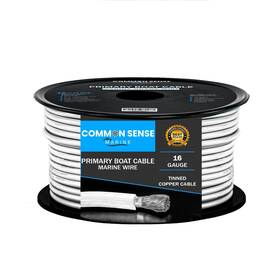
( Brand: Common Sense Marine ), ( Manufacturer Part Number: MW16-WH-100 ), ( Part Type: Boat Gauge Cable ), ( Size: 100 Feet ), ( Color: White ), ( Voltage: 600.0 ), ( Material: Copper ), ( Unit Count: 100.0 ), ( Strands: Multi Strand ), ( Package Dimensions Lxwxh: 5.0x4.9x2.3 Inches ), ( Weight: 1.55 Pounds )
Review COMMON SENSE MARINE Gauge Primary Boat Cable 100 Ft Wire Tinned Oxygen free Copper Awg
The **Common Sense Marine MW16-WH-100 16-Gauge Boat Cable (100 Feet, White, Tinned Oxygen-Free Copper, AWG)** is a premium-quality marine-grade electrical cable engineered to deliver superior performance, durability, and reliability in the demanding environments of boats, yachts, and marine applications. Constructed from **tinned oxygen-free copper (OFC)**, this cable offers an exceptional combination of conductivity, corrosion resistance, and mechanical strength, making it ideal for both primary and secondary wiring systems where longevity and current-carrying capacity are critical. The **16-gauge (AWG) wire** strikes a balance between flexibility and current-handling ability, ensuring smooth installation while efficiently supporting typical marine loads such as lighting, navigation systems, bilge pumps, and other electrical accessories without excessive voltage drop. The **white PVC insulation** provides a clean, professional appearance while offering UV resistance and resistance to abrasion, oil, and moisture key factors that prevent degradation in the harsh marine environment. This cable is **marine-worthy (MW)** by design, featuring a robust construction that resists saltwater corrosion, vibration, and temperature fluctuations, which are common challenges aboard vessels. Whether used for new installations or replacements in fishing boats, sailboats, or powerboats, this cable ensures a secure and long-lasting electrical connection, reducing the risk of shorts, oxidation, or performance issues. Its **100-foot length** offers ample coverage for most marine wiring projects, from under-deck runs to exterior installations, while the **tinned copper strands** enhance solderability and prevent oxidation at connection points, ensuring a reliable bond for terminations. Built to meet or exceed industry standards, this cable is a trusted choice for marine electricians, DIY enthusiasts, and boat owners who demand nothing less than the highest quality in their electrical systems.
### **Pros and Cons of buying a Common Sense Marine MW16-WH-100 (16-Gauge Boat Cable, 100-Foot, Tinned Oxygen-Free Copper, AWG)**
#### **Pros:**1. **High-Quality Copper Construction** The cable is made from **tinned oxygen-free copper (TOFC)**, which is highly conductive, corrosion-resistant, and durable. This ensures minimal voltage drop and long-term reliability, especially in marine environments where saltwater and humidity can degrade cheaper materials.
2. **Marine-Grade Insulation** Designed for boat applications, the insulation is likely **UV-resistant, waterproof, and flexible**, making it suitable for outdoor and wet conditions. This prevents degradation from exposure to sunlight, salt spray, or moisture.
3. **Thick Gauge (16 AWG) for Heavy-Duty Use** A **16-gauge wire** is thicker than common household wiring (e.g., 18 or 14 AWG), meaning it can handle **higher amperage** without overheating. This is ideal for marine electrical systems, which often require robust wiring for starter motors, batteries, or auxiliary circuits.
4. **Pre-Tinned Connections** The tinned copper ensures **easier soldering and crimping**, reducing resistance at connections. This is particularly useful for DIY installers who may need to terminate the wire themselves.
5. **Long Length (100 Feet)** A **100-foot cable** provides ample length for most boat wiring needs, whether for engine wiring, bilge pumps, or auxiliary circuits. This eliminates the need for multiple splices or extensions.
6. **Reliability in Harsh Conditions** Marine environments are tough on wiring due to vibration, temperature fluctuations, and corrosive elements. This cable is built to withstand these stresses better than standard household wire.
7. **Compatibility with Marine Systems** The **marine-grade rating** suggests it meets industry standards for boat electrical systems, including **shock resistance, flexibility, and resistance to abrasion**.
---
#### **Cons:**1. **Higher Upfront Cost** Marine-grade cables, especially those made from **oxygen-free copper (OFC)**, are more expensive than standard household wiring. If you're on a tight budget, this may be a drawback.
2. **Overkill for Small or Light-Duty Applications** If you're wiring a **small trolling motor, a single LED light, or a minor accessory**, a **16-gauge cable may be unnecessarily thick**. Thinner gauges (e.g., 18 or 20 AWG) could suffice, reducing cost and weight.
3. **Potential for Overcomplicating Installations** For beginners, a **thick, marine-rated cable** may require more careful handling during installation (e.g., proper crimping, sealing connections) to avoid shorts or poor connections.
4. **Weight Consideration** Copper is **heavy**, and a **100-foot 16-gauge cable** will add significant weight to your boat. If storage space is limited, this could be a minor inconvenience.
5. **Availability of Alternatives** If you're not strictly needing **marine-grade** wire, there may be **cheaper, equally effective options** (e.g., **THHN or XHHW-2 wire** in some cases), though these may not be as durable in saltwater environments.
6. **Potential for Overwiring** If your boat s electrical system is **small or low-voltage**, a **16-gauge cable may be more than needed**, leading to unnecessary expense without significant benefit.
---
### **Conclusion:**The **Common Sense Marine MW16-WH-100 (16-gauge, tinned OFC, 100-foot)** is an **excellent choice for serious boaters, DIY marine electricians, or anyone requiring a **durable, high-performance cable** for **engine wiring, battery connections, or heavy-duty auxiliary circuits**. Its **superior conductivity, corrosion resistance, and marine-grade insulation** make it far more reliable than standard household wire in harsh conditions.
However, if you're working on a **small boat, low-voltage system, or budget-conscious project**, a **thinner gauge (18 or 20 AWG) or a non-marine cable** might be sufficient. The **extra cost and weight** of this cable may not be justified for minor applications.
---
### **Recommendation:** - **Buy this cable if:**- You need **reliable, long-lasting wiring** for a **motorboat, sailboat, or fishing vessel**.
- Your electrical system involves **high-amperage loads (starter motors, alternators, large batteries)**.
- You want **easy soldering and corrosion resistance** in a **saltwater environment**.
- You prefer **one long, high-quality cable** over multiple splices.
- **Consider alternatives if:**- You're working on a **small boat or low-power system** where a thinner gauge would suffice.
- You're on a **tight budget** and can find a **marine-rated 18-gauge cable** that meets your needs.
- You're **not experienced with marine wiring** and may struggle with proper termination.
**Final Verdict:** For most **serious boaters and DIY marine electricians**, this cable is a **worthwhile investment** due to its **durability, performance, and longevity**. If you're unsure, test a small section first or consult a marine electrician before committing.
Details:
All of our boat wire is pre-tinned, which helps resist corrosion and length ens the life. This single-conductor insulated boat wire uses Type III fine stranded copper and features a durable PVC jacket. Boat wire is BC-5W2 compliant and UL 1426 listed, meets ABYC USCG specifications, which allows it to survive harsh environments.
part #: mw16wh100 prices
- $55.63-$151.41
specifications electricalmiscoz:
- brand: Common Sense Marine
- mpn: Mw16-wh-100
- part type: Boat Gauge Cable
- size: 100 Feet
- color: White
- voltage: 600.0
- material: Copper
- unit count: 100.0
- strands: Multi Strand
- package dimensions lxwxh: 5.0x4.9x2.3 Inches
- weight: 1.55 Pounds
seller electricalmiscoz:
- # reviews: 465
- city: Knoxville, Tennessee
- rating: 99.1%
payments electricalmiscoz:
- credit card: Visa
- wallet: Google-pay
- other
general electricalmiscoz:
- condition: New
- Electrical Supplies > Electrical Wire Cable Accessories > Electrical Wire Cable Connectors
shipping electricalmiscoz:
- class: Standard
- type: Fixed
- cost: $0.00
- transit: 4-8 Days
- service: USPS First Class Letter
- carrier: USPS
offer electricalmiscoz:
- options: Ship-to-home
- sold: 0
- quantity: 1
- started: May 26, 2026
- availability: In Stock
returns electricalmiscoz:
- time: 30 Days
- paid by: Seller
- policy: Returns Accepted
- method: Money back
Common Sense Marine MW16-WH-100 Is Similar To:
- Mw8-3-13 Common Sense Marine Awg Ul Spec Reqd Triplex Flat Ac (28% similar) High strand count tinned copper conductor type iii for low resistance, high conductivity and protection from corrosion. This triple conductor insulated boat wire uses type iii fine stranded copper wire, and features a durable PVC jacket with polypropylene filler. The Common Sense Marine MW8-3-13 is ...(February 22nd, 2022)
- Common Sense Marine Mw8-rd-30 8 Gauge Primary Boat Cable 30 Ft Grade Wire Tinned Oxygen-free Copper (87.3% similar) All of our boat wire is pre-tinned, which helps resist corrosion and length ens the life. Common Sense Marine boat wire is BC-5W2 compliant and ul 1426 listed, meets ABC USCG specifications, which allows it to survive harsh Marine environments. This single-conductor insulated boat wire uses type ...(March 31st, 2025)
- Common Sense Marine 313055164123 8 Awg Ul 1426 The Real Thing Wire Tinned Copper Primary battery Boat (49.5% similar) High strand count tinned copper conductor type iii for low resistance, high conductivity and protection from corrosion. 8 awg ul 1426 the real thing Marine wire - tinned copper primary/battery boat:: number of cable strands 30, color red, brand Common Sense Marine, material copper, gauge 8.0, ...(April 1st, 2025)
- Common Sense Marine Mw14-2-18 14 2 Awg Ul Spec Reqd Duplex Flat Dc Wire Tinned Copper Boat Cable 18 (54.5% similar) Approved by the us coast guard and compliant with ul 1426 standards, this boat cable is a trusted choice for Marine wiring applications. The multi-strand design provides flexibility during installation. Invest in reliability and safety with. It ensures optimal performance in demanding Marine ...(April 2nd, 2025)
- Common Sense Marine Mw16-2-rdbk-30 16 2 Awg Ul 1426 The Real Thing Duplex Flat Wire Tinned Copper Boat Cab (56.5% similar) All of our boat wire is pre-tinned, which helps resist corrosion and length ens the life. Elevate your Marine experience with our 16 awg electrical wire, perfect for pontoon boats, bass boat trailers, trucks, RVs, vans, and ATV trailer systems. This dual conductor insulated boat wire uses type iii ...(April 3rd, 2025)
- Common Sense Marine Mw12-2r-rdbk-30 12 Gauge 2 Conductor Wire 30 Ft Duplex Round Grade Tinne (54.8% similar) Boat wire is BC-5W2 compliant and ul 1426 listed, meets ABC USCG specifications, which allows it to survive harsh Marine environments. Premium PVC shielding: our top-tier insulation not only fends off moisture, flame, acid, alkali, oil, and gasoline but also boasts rhos-compliant materials. 0.76MM...(April 3rd, 2025)
- Common Sense Marine Mw6-rd-30 6 Gauge Primary Boat Cable 30 Ft Grade Wire Tinned Oxygen-free Coppe (88.7% similar) This single-conductor insulated boat wire uses type iii fine stranded copper and features a durable PVC jacket. Boat wire is BC-5W2 compliant and ul 1426 listed, meets ABC USCG specifications, which allows it to survive harsh Marine environments. All of our boat wire is pre-tinned, which helps ...(April 3rd, 2025)
- Common Sense Marine Mw18-wh-100 18 Awg Ul 1426 The Real Thing Wire Tinned Copper Primary Boat Cable 1 (54.9% similar) All of our boat wire is pre-tinned, which helps resist corrosion and length ens the life. 18 gauge boat wire is BC-5W2 compliant and meets ul 1426, ABC, USCG specifications, which allows it to survive harsh Marine environments. This single-conductor insulated boat wire uses type iii fine stranded ...(April 3rd, 2025)
- Common Sense Marine Mw6-2-rdbk-30 6 2 Awg Ul 1426 The Real Thing Duplex Flat Wire Tinned Copper Boat (55.6% similar) This dual conductor insulated boat wire uses type iii fine stranded copper wire, and features a durable PVC jacket. Elevate your Marine experience with our 6 awg electrical wire, perfect for pontoon boats, bass boat trailers, trucks, RVs, vans, and ATV trailer systems. It is rated for 600 volts , ...(April 4th, 2025)
- Common Sense Marine Mw16-gr-60 16 Gauge Primary Boat Cable 60 Ft Grade Wire Tinned Oxygen-free Copp (89.2% similar) Boat wire is BC-5W2 compliant and ul 1426 listed, meets ABC USCG specifications, which allows it to survive harsh Marine environments. This single-conductor insulated boat wire uses type iii fine stranded copper and features a durable PVC jacket. All of our boat wire is pre-tinned, which helps ...(April 5th, 2025)
- Common Sense Marine Mw2-bk-30 2 Gauge Primary Boat Cable 30 Ft Grade Wire Tinned Oxygen-free Coppe (86.7% similar) This single-conductor insulated boat wire uses type iii fine stranded copper and features a durable PVC jacket. All of our boat wire is pre-tinned, which helps resist corrosion and length ens the life. Boat wire is BC-5W2 compliant and ul 1426 listed, meets ABC USCG specifications, which allows it ...(April 5th, 2025)