COMMON SENSE MARINE MW14-GR-30 Gauge Boat Cable Wire Tinned Copper Oxygen 30-FT Awg
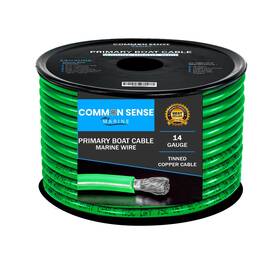
( Brand: Common Sense Marine ), ( Manufacturer Part Number: MW14-GR-30 ), ( Part Type: Boat Gauge Cable ), ( Size: 30 Feet ), ( Color: Green ), ( Voltage: 600.0 ), ( Material: Copper ), ( Unit Count: 1.0 ), ( Strands: Multi Strand ), ( Package Dimensions Lxwxh: 4.1x3.2x1.5 Inches ), ( Weight: 0.6 Pounds )
Review COMMON SENSE MARINE Gauge Primary Boat Cable 30 Ft Wire Tinned Oxygen free Copper Awg
The **Common Sense Marine MW14-GR-30 14-Gauge Boat Cable (30 ft, Tinned Oxygen-Free Copper, AWG)** is a high-performance marine-grade electrical cable engineered to deliver reliable, corrosion-resistant power for demanding onboard applications. Constructed from **tinned oxygen-free copper (TOFC)**, this cable offers superior conductivity and resistance to oxidation, ensuring consistent current flow even in harsh marine environments where saltwater, humidity, and vibration can degrade standard wiring. The **14-gauge (AWG) conductor** provides a balanced trade-off between flexibility and current-carrying capacity, making it ideal for medium-duty circuits such as bilge pumps, lighting systems, bilge blowers, and auxiliary electronics where durability and longevity are critical. The **30-foot length** offers ample reach for most below-deck or engine compartment installations without excessive bulk, while the **marine-grade insulation** is designed to withstand UV exposure, abrasion, and temperature fluctuations, preventing premature degradation. Whether used in recreational boats, fishing vessels, or small commercial craft, this cable ensures a secure connection with minimal voltage drop, reducing the risk of overheating or equipment failure. Its robust construction and corrosion-resistant properties make it a trusted choice for marine electricians and DIY enthusiasts alike, providing peace of mind with every installation.
**Pros and Cons of buying a Common Sense Marine MW14-GR-30 (14-Gauge Boat Cable, 30 ft, Tinned Oxygen-Free Copper, AWG)**
### **Pros**
1. **High-Quality Copper Construction** The cable is made from **tinned oxygen-free copper (TOFC)**, which is highly conductive and resistant to corrosion. This ensures better electrical performance and longevity compared to cheaper alternatives with lower-grade copper or tinned coatings that may degrade over time.
2. **Marine-Grade Durability** Designed for marine applications, the cable is likely built to withstand **moisture, saltwater exposure, and vibration**, which are common challenges in boating environments. The **14-gauge thickness** provides a good balance between conductivity and strength for most marine electrical needs.
3. **Reliable Tinned Coating** The tin plating helps prevent **oxidation and corrosion**, reducing the risk of poor connections or cable failure over time. This is particularly useful in humid or saltwater environments where unprotected copper can degrade quickly.
4. **AWG Standardization** Being **AWG 14** means it meets standard electrical load ratings, making it suitable for **12V marine systems, bilge pumps, lights, and small appliances** without overloading circuits. It s a common gauge for marine wiring, ensuring compatibility with most marine electrical components.
5. **Flexibility and Workability** Oxygen-free copper is softer and more pliable than some other copper alloys, making it easier to **strip, terminate, and route** without cracking. This is useful for DIY installers or those working in tight spaces.
6. **Brand Reputation** Common Sense Marine is a well-known brand in the marine industry, often associated with **reliable, performance-oriented products**. While not the absolute premium choice (like LMR or Southwire), it strikes a balance between cost and quality.
7. **Cost-Effective for Basic Needs** Compared to **pre-wired marine cables with connectors**, this bare cable is **cheaper upfront**, making it a good option for budget-conscious buyers who plan to terminate it themselves (e.g., with crimp connectors or solder).
8. **Wide Availability** As a common gauge and type, it is **easily found in marine supply stores, online retailers (Amazon, West Marine, BoatUS), and hardware stores**, reducing lead times.
---
### **Cons**
1. **No Built-In Protection Against Water Ingress** This is **bare cable with no jacket or insulation beyond the tinned copper**. While the tin coating helps, it does **not** provide physical protection against abrasion, UV exposure, or deep water submersion. For exposed wiring (e.g., on deck or in open compartments), additional **marine-grade conduit or tubing** is required.
2. **Requires Proper Termination Skills** Since it s bare wire, you must **strip, crimp, or solder connectors** yourself. Poor terminations can lead to **corrosion, loose connections, or electrical failures**. Beginners may struggle with this unless they invest in proper tools (crimping tool, wire strippers, heat shrink tubing).
3. **Not Pre-Wired for Convenience** Unlike **pre-made marine cables with plugs and connectors**, this cable must be **custom-terminated** for your specific application. This adds time and effort, especially if you re not experienced with wiring.
4. **Limited Current-Carrying Capacity for Heavy Loads** While **AWG 14 is suitable for most 12V marine systems**, it is **not ideal for high-amperage applications** (e.g., large alternators, high-wattage inverters, or multiple high-draw devices on the same circuit). For such cases, **thicker gauges (e.g., 10 or 12 AWG)** are recommended to prevent overheating.
5. **Potential for Oxidation Over Time** Even with a tinned coating, **prolonged exposure to moisture or saltwater can cause pitting or corrosion** at connection points. Regular maintenance (e.g., cleaning terminals, applying dielectric grease) is necessary to prevent issues.
6. **No Built-In Strain Relief** Without proper securing (e.g., using **clamp connectors, grommets, or strain relief boots**), the cable can **pull loose from terminals**, leading to failed connections.
7. **May Not Meet All Marine Certifications** While designed for marine use, it may **not carry specific marine certifications** (e.g., ABS, UL Marine) that some manufacturers require for warranty or insurance purposes. Always check if your application demands certified marine-grade wiring.
8. **Higher Risk of Short Circuits in Wet Environments** If the cable is **not properly insulated or routed**, water exposure could cause **shorts or ground faults**, especially in engine compartments or bilges.
---
### **Ending Conclusion**
The **Common Sense Marine MW14-GR-30** is a **solid, cost-effective choice for basic marine electrical wiring** where **proper installation and maintenance** are ensured. It excels in **conductivity, corrosion resistance, and ease of use for DIY projects**, making it ideal for:
- **Bilge pump wiring**
- **Lighting circuits**
- **Small appliance connections**
- **Aftermarket alternator or battery wiring (if amperage is within safe limits)**
However, it is **not a plug-and-play solution** it requires **careful handling, proper termination, and protection** to prevent failure. If you re **not comfortable with wiring**, consider **pre-made marine cables with connectors** or **pre-jacketed marine wire** for added convenience and safety.
For **high-reliability applications** (e.g., engine wiring, critical safety circuits, or high-amperage systems), **thicker gauges (10 or 12 AWG) with marine-grade insulation** or **certified pre-wired cables** may be worth the extra cost.
---
### **Final Recommendation**
**Buy this cable if:**You need **reliable, high-quality copper wire** for **low-to-medium amperage marine electrical work**.
You are **willing to invest time in proper termination** (crimping, soldering, or using marine connectors).
You plan to **protect the cable** (e.g., with conduit, tubing, or strain relief) from moisture and abrasion.
You re working on **non-critical systems** (e.g., lights, bilge pumps) where a DIY approach is feasible.
**Avoid this cable if:**You need **pre-made, ready-to-use wiring** without termination effort.
Your application requires **high amperage** (e.g., large alternators, inverters, or multiple high-draw devices).
You re **not experienced with electrical wiring** and cannot ensure proper connections.
The cable will be **exposed to harsh conditions without protection** (e.g., running bare on deck without conduit).
**Alternative Considerations:**- For **easier installation**, opt for **pre-wired marine cables** (e.g., with Anderson or marine plugs).
- For **higher durability**, choose **marine-grade jacketed wire** (e.g., Southwire Marine, LMR).
- For **heavy-duty applications**, upgrade to **10 or 12 AWG** for better current capacity.
If you proceed with this cable, **prioritize quality connectors, dielectric grease, and proper routing** to maximize its lifespan and reliability.
Details:
Boat wire is BC-5W2 compliant and UL 1426 listed, meets ABYC USCG specifications, which allows it to survive harsh environments. All of our boat wire is pre-tinned, which helps resist corrosion and length ens the life. This single-conductor insulated boat wire uses Type III fine stranded copper and features a durable PVC jacket.
part #: mw14gr30 prices
- $69.44-$134.59
specifications electricalmiscoz:
- brand: Common Sense Marine
- mpn: Mw14-gr-30
- part type: Boat Gauge Cable
- size: 30 Feet
- color: Green
- voltage: 600.0
- material: Copper
- unit count: 1.0
- strands: Multi Strand
- package dimensions lxwxh: 4.1x3.2x1.5 Inches
- weight: 0.6 Pounds
general electricalmiscoz:
- Electrical Supplies > Electrical Wire Cable Accessories > Electrical Wire Cable Connectors
- condition: New
payments electricalmiscoz:
- wallet: Apple-pay
- other
- credit card: Visa
returns electricalmiscoz:
- time: 30 Days
- policy: Returns Accepted
- paid by: Seller
- method: Money back
seller electricalmiscoz:
- # reviews: 227
- city: Chicago, Illinois
- rating: 99.5%
shipping electricalmiscoz:
- service: USPS First Class Letter
- carrier: USPS
- type: Fixed
- cost: $0.00
- class: Standard
- transit: 3-8 Days
offer electricalmiscoz:
- sold: 0
- started: March 2, 2026
- availability: In Stock
- options: Ship-to-home
- quantity: 1
Common Sense Marine MW14-GR-30 Is Similar To:
- Mw8-3-13 Common Sense Marine Awg Ul Spec Reqd Triplex Flat Ac (30.5% similar) High strand count tinned copper conductor type iii for low resistance, high conductivity and protection from corrosion. This triple conductor insulated boat wire uses type iii fine stranded copper wire, and features a durable PVC jacket with polypropylene filler. The Common Sense Marine MW8-3-13 is ...(February 22nd, 2022)
- Common Sense Marine Mw8-rd-30 8 Gauge Primary Boat Cable 30 Ft Grade Wire Tinned Oxygen-free Copper (90.2% similar) All of our boat wire is pre-tinned, which helps resist corrosion and length ens the life. Common Sense Marine boat wire is BC-5W2 compliant and ul 1426 listed, meets ABC USCG specifications, which allows it to survive harsh Marine environments. This single-conductor insulated boat wire uses type ...(March 31st, 2025)
- Common Sense Marine 313055164123 8 Awg Ul 1426 The Real Thing Wire Tinned Copper Primary battery Boat (50.5% similar) High strand count tinned copper conductor type iii for low resistance, high conductivity and protection from corrosion. 8 awg ul 1426 the real thing Marine wire - tinned copper primary/battery boat:: number of cable strands 30, color red, brand Common Sense Marine, material copper, gauge 8.0, ...(April 1st, 2025)
- Common Sense Marine Mw14-2-18 14 2 Awg Ul Spec Reqd Duplex Flat Dc Wire Tinned Copper Boat Cable 18 (56.4% similar) Approved by the us coast guard and compliant with ul 1426 standards, this boat cable is a trusted choice for Marine wiring applications. The multi-strand design provides flexibility during installation. Invest in reliability and safety with. It ensures optimal performance in demanding Marine ...(April 2nd, 2025)
- Common Sense Marine Mw16-2-rdbk-30 16 2 Awg Ul 1426 The Real Thing Duplex Flat Wire Tinned Copper Boat Cab (60.3% similar) All of our boat wire is pre-tinned, which helps resist corrosion and length ens the life. Elevate your Marine experience with our 16 awg electrical wire, perfect for pontoon boats, bass boat trailers, trucks, RVs, vans, and ATV trailer systems. This dual conductor insulated boat wire uses type iii ...(April 3rd, 2025)
- Common Sense Marine Mw12-2r-rdbk-30 12 Gauge 2 Conductor Wire 30 Ft Duplex Round Grade Tinne (57.9% similar) Boat wire is BC-5W2 compliant and ul 1426 listed, meets ABC USCG specifications, which allows it to survive harsh Marine environments. Premium PVC shielding: our top-tier insulation not only fends off moisture, flame, acid, alkali, oil, and gasoline but also boasts rhos-compliant materials. 0.76MM...(April 3rd, 2025)
- Common Sense Marine Mw6-rd-30 6 Gauge Primary Boat Cable 30 Ft Grade Wire Tinned Oxygen-free Coppe (89.7% similar) This single-conductor insulated boat wire uses type iii fine stranded copper and features a durable PVC jacket. Boat wire is BC-5W2 compliant and ul 1426 listed, meets ABC USCG specifications, which allows it to survive harsh Marine environments. All of our boat wire is pre-tinned, which helps ...(April 3rd, 2025)
- Common Sense Marine Mw18-wh-100 18 Awg Ul 1426 The Real Thing Wire Tinned Copper Primary Boat Cable 1 (50% similar) All of our boat wire is pre-tinned, which helps resist corrosion and length ens the life. 18 gauge boat wire is BC-5W2 compliant and meets ul 1426, ABC, USCG specifications, which allows it to survive harsh Marine environments. This single-conductor insulated boat wire uses type iii fine stranded ...(April 3rd, 2025)
- Common Sense Marine Mw6-2-rdbk-30 6 2 Awg Ul 1426 The Real Thing Duplex Flat Wire Tinned Copper Boat (59.5% similar) This dual conductor insulated boat wire uses type iii fine stranded copper wire, and features a durable PVC jacket. Elevate your Marine experience with our 6 awg electrical wire, perfect for pontoon boats, bass boat trailers, trucks, RVs, vans, and ATV trailer systems. It is rated for 600 volts , ...(April 4th, 2025)
- Common Sense Marine Mw16-gr-60 16 Gauge Primary Boat Cable 60 Ft Grade Wire Tinned Oxygen-free Copp (89.2% similar) Boat wire is BC-5W2 compliant and ul 1426 listed, meets ABC USCG specifications, which allows it to survive harsh Marine environments. This single-conductor insulated boat wire uses type iii fine stranded copper and features a durable PVC jacket. All of our boat wire is pre-tinned, which helps ...(April 5th, 2025)
- Common Sense Marine Mw2-bk-30 2 Gauge Primary Boat Cable 30 Ft Grade Wire Tinned Oxygen-free Coppe (88.7% similar) This single-conductor insulated boat wire uses type iii fine stranded copper and features a durable PVC jacket. All of our boat wire is pre-tinned, which helps resist corrosion and length ens the life. Boat wire is BC-5W2 compliant and ul 1426 listed, meets ABC USCG specifications, which allows it ...(April 5th, 2025)